


TL;DR

Decimal odds show the total potential return, including the original stake. The basic formula is: Stake × Decimal Odds = Potential Total Return

Example: ₫100,000 × 1.90 = ₫190,000. Potential profit: ₫190,000 − ₫100,000 = ₫90,000

Higher decimal odds generally indicate a lower implied probability, while lower odds generally indicate a higher implied probability according to the market. Odds do not guarantee that an outcome will occur.
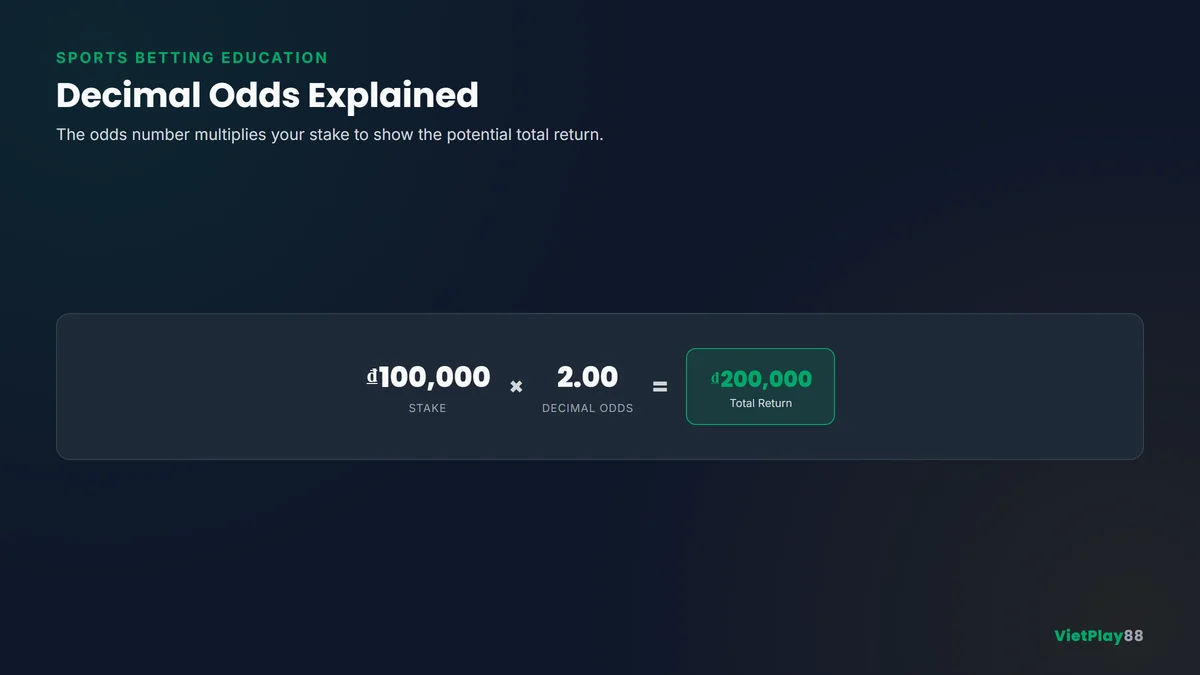
Decimal betting odds infographic showing stake odds potential return and profit calculations

What Are Decimal Odds?

Decimal Odds are a numerical representation of a sportsbook's price for a betting selection.

Decimal OddsExample Display
1.40Favorite
1.80Moderate Favorite
2.00Even-style price
3.00Higher-return selection
5.00Lower implied probability

These descriptions are only general illustrations. The actual strength of an outcome depends on the sport, market, and sportsbook pricing.

How Do Decimal Odds Work?

The easiest way to understand decimal odds is to remember:

The displayed number multiplies the stake to determine the potential total return.

Formula:

Stake × Decimal Odds = Potential Total Return

Example. Stake: ₫200,000. Odds: 1.75

₫200,000 × 1.75 = ₫350,000

Potential total return: ₫350,000

Potential profit: ₫350,000 − ₫200,000 = ₫150,000

Total Return vs Profit

This distinction is important. Decimal odds normally show the multiplier used to calculate the total return, not profit alone.

For example. Stake: ₫100,000. Odds: 2.50

Total return: ₫250,000. Profit: ₫150,000

The original ₫100,000 stake is included in the total return.

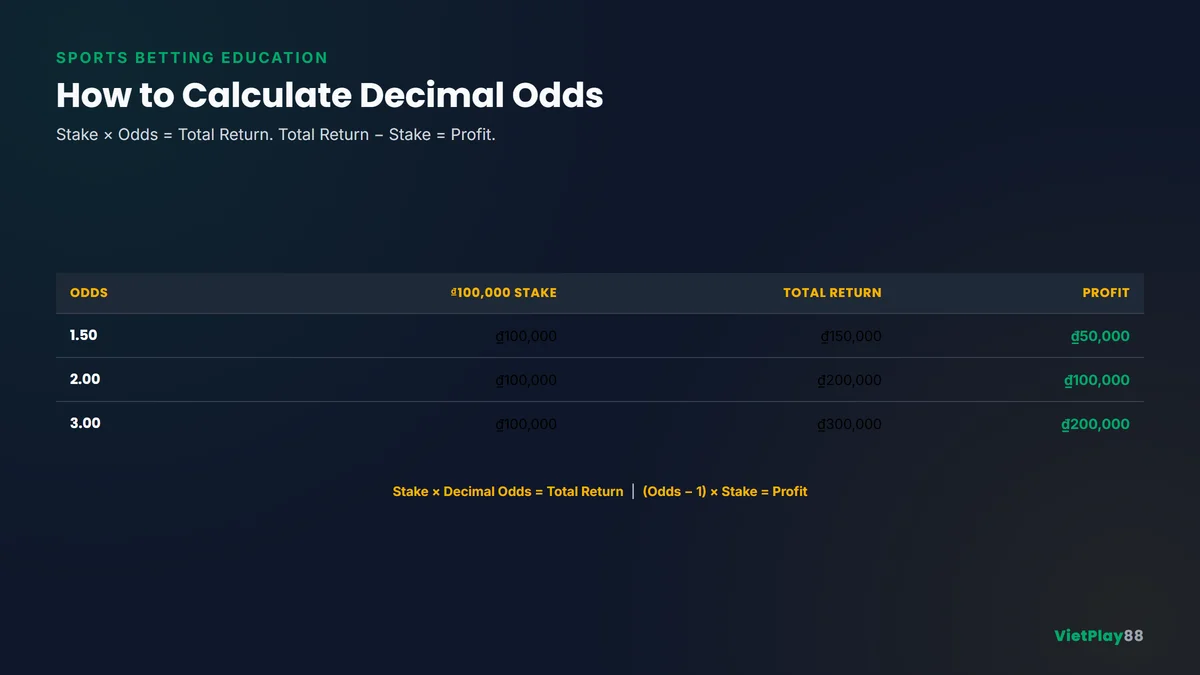
Decimal Odds Formula

There are two useful formulas.

Potential Total Return

Stake × Decimal Odds

Potential Profit

(Decimal Odds − 1) × Stake

Example. Odds: 1.80. Stake: ₫500,000

Total Return: ₫500,000 × 1.80 = ₫900,000

Profit: (1.80 − 1) × ₫500,000 = 0.80 × ₫500,000 = ₫400,000

Decimal odds calculation guide showing total return and potential profit formulas

Example: Decimal Odds 1.50

Suppose. Stake: ₫100,000. Odds: 1.50

Total return: ₫100,000 × 1.50 = ₫150,000

Potential profit: ₫50,000

If the wager loses, the stake is lost according to the sportsbook's settlement rules.

Example: Decimal Odds 2.00

Suppose. Stake: ₫100,000. Odds: 2.00

Total return: ₫200,000. Potential profit: ₫100,000

Odds of 2.00 therefore double the stake in the total-return calculation if the wager wins.

Example: Decimal Odds 3.50

Suppose. Stake: ₫100,000. Odds: 3.50

Potential total return: ₫350,000. Potential profit: ₫250,000

The larger potential return reflects a lower implied probability according to the offered price. It does not mean the wager has better value automatically.

Comparing Decimal Odds

Consider three hypothetical selections.

SelectionDecimal Odds₫100,000 Total ReturnPotential Profit
Team A1.50₫150,000₫50,000
Team B2.00₫200,000₫100,000
Team C4.00₫400,000₫300,000

Higher odds create a larger potential return. However, sportsbooks generally assign higher odds to outcomes they price as less likely.

What Does 1.01 Mean?

Decimal odds can sometimes be very low. Example: 1.01

A ₫100,000 stake would produce: ₫100,000 × 1.01 = ₫101,000. Potential profit: ₫1,000

Very low odds generally imply that the sportsbook views the outcome as highly probable. However: Highly probable ≠ guaranteed. Even selections with very low odds can lose.

What Does 10.00 Mean?

Consider: 10.00

A ₫100,000 stake would produce: ₫1,000,000 total return. Potential profit: ₫900,000

The high price indicates a much lower implied probability. A large potential return should therefore not be confused with a "better" or safer wager.

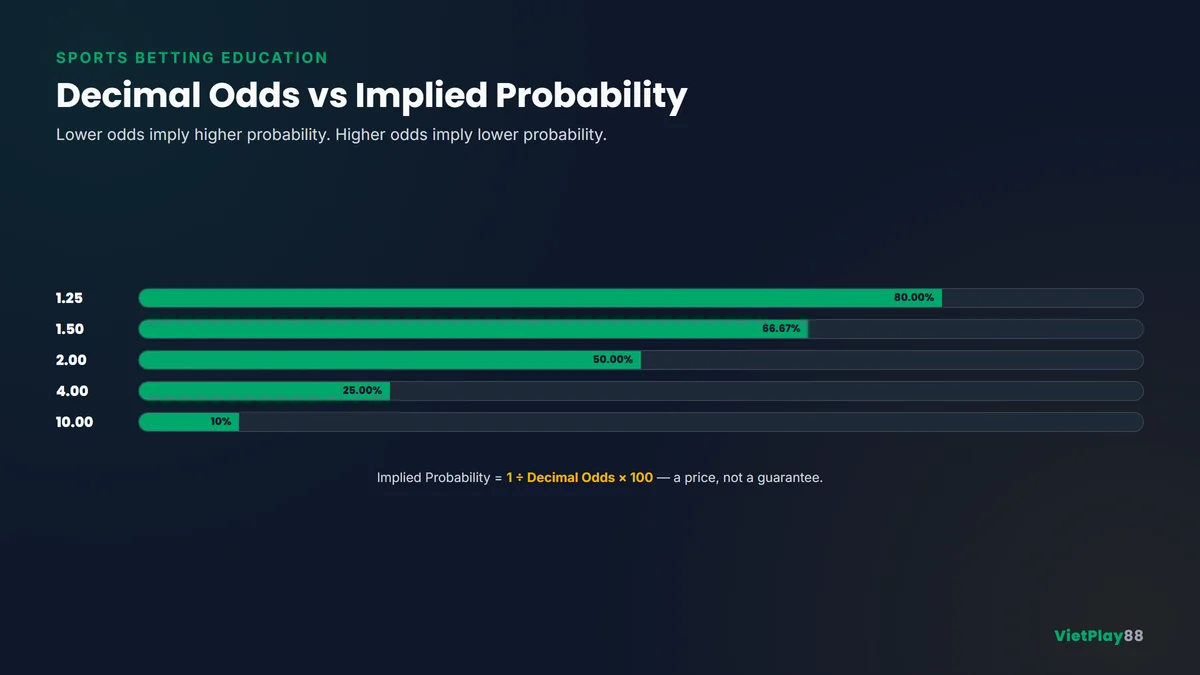
Decimal Odds and Implied Probability

Decimal Odds can be converted into an approximate implied probability. The basic formula is:

1 ÷ Decimal Odds × 100

For example. Odds: 2.00

Calculation: 1 ÷ 2.00 × 100 = 50%

Example: 1.50 Odds as Probability

1 ÷ 1.50 × 100

Approximately: 66.67%

This means 1.50 odds correspond to an implied probability of approximately 66.67% before considering sportsbook margin.

Example: 4.00 Odds as Probability

1 ÷ 4.00 × 100 = 25%

Implied probability: 25%

Again, this is the mathematical probability implied by the price. It does not guarantee the actual outcome.

Decimal Odds and Implied Probability Table

Decimal OddsApprox. Implied Probability
1.2580.00%
1.5066.67%
1.8055.56%
2.0050.00%
2.5040.00%
3.0033.33%
4.0025.00%
5.0020.00%
10.0010.00%

These percentages are simplified and do not remove sportsbook margin.

Decimal odds and implied probability comparison showing examples from 1.25 to 10.00

Why Do Sportsbook Probabilities Add Up to More Than 100%?

Sportsbooks usually include a margin in their prices. Consider a simple two-outcome market:

Team A: 1.90
Team B: 1.90

Implied probability for each: 1 ÷ 1.90 ≈ 52.63%

Combined: 52.63% + 52.63% = 105.26%

The amount above 100% reflects the sportsbook's built-in margin in this simplified example. This concept is sometimes called Overround, Vig, Juice, or Bookmaker Margin.

Decimal Odds in Football Betting

Football Betting sportsbooks commonly use decimal odds for markets such as Match Winner, Asian Handicap, Over/Under, BTTS, Correct Score, and Player Props.

Example: Home Win: 1.85. Draw: 3.40. Away Win: 4.20

Each price represents the potential total-return multiplier for the selected outcome.

Decimal Odds in Basketball Betting

Basketball markets may display: Team A Moneyline: 1.65. Team B Moneyline: 2.30

Other markets include Point Spread, Over/Under, Player Props, and Quarter Betting. The decimal calculation remains the same regardless of sport.

Decimal Odds in Tennis Betting

Example: Player A: 1.45. Player B: 2.80

A ₫100,000 wager on Player B at 2.80 would have ₫280,000 potential total return if successful. Again, this does not indicate that the higher-priced player is a better wager.

Decimal Odds and Live Betting

Live Sports Betting odds can change rapidly during an event.

For example, before kickoff: Team A: 1.80. After conceding a goal: Team A: 3.20

The potential return changes because the sportsbook's price has changed based on the live situation and market conditions. Live odds should always be reviewed immediately before confirming a wager.

Do Higher Decimal Odds Mean Better Value?

Not necessarily. Higher odds simply create a larger potential return relative to the stake.

For example, odds of 8.00 offer a much larger potential return than odds of 1.50, but it also typically reflects a substantially lower implied probability.

Determining whether odds represent "value" requires comparing the offered price with an independent estimate of probability. Even then, no result is guaranteed.

What Is a Value Bet?

A value bet is a concept where a bettor believes:

The true probability of an outcome is higher than the probability implied by the sportsbook odds.

Example. Sportsbook price: 2.50. Implied probability: 40%

If someone independently estimates the actual probability at 45%, they may consider the price to offer theoretical value. However, probability estimates can be wrong. Value does not guarantee that a specific wager will win.

Decimal Odds vs Fractional Odds

Fractional odds may appear as 5/2, while the approximate decimal equivalent is 3.50

Decimal odds include the original stake in the displayed return multiplier, while fractional odds traditionally describe profit relative to stake.

Decimal Odds vs American Odds

American odds use positive and negative numbers such as +150 or -200. Decimal odds use a single multiplier such as 2.50 or 1.50

All three formats describe sportsbook prices. They simply present the information differently.

Why Decimal Odds Are Easy for Beginners

Decimal odds are often considered beginner-friendly because the calculation is straightforward. For any stake:

Multiply the stake by the displayed odds.

Example: ₫250,000 × 2.20 = ₫550,000

No additional conversion is required to calculate total return.

Common Decimal Odds Mistakes

Mistake 1: Thinking the Displayed Odds Represent Profit Only

False. Decimal odds calculate the total return including the original stake.

Mistake 2: Thinking Higher Odds Mean a Better Bet

False. Higher odds generally reflect lower implied probability.

Mistake 3: Treating Implied Probability as Certainty

A 75% implied probability does not mean the outcome is guaranteed.

Mistake 4: Forgetting the Sportsbook Margin

Displayed odds generally include operator margin.

Mistake 5: Using Old Live Odds

Live prices can change rapidly. Always review the current price before confirming a wager.

Mistake 6: Confusing 2.00 Odds With 200% Profit

At 2.00 odds, the total return is twice the stake. The profit itself equals the original stake.

Responsible Use of Betting Odds

Understanding Decimal Odds helps players read sportsbook prices, but it does not remove Sports Betting risk. Responsible practices include:

  • Understand the odds before placing a wager.
  • Calculate the potential stake and return.
  • Set an entertainment budget.
  • Avoid choosing bets solely because the odds are high.
  • Avoid chasing losses.
  • Take regular breaks.
  • Never borrow money to bet.
  • Treat sportsbook odds as prices rather than predictions of certainty, per the Responsible Gaming guide.

Every sporting event remains uncertain regardless of the displayed odds. Readers exploring specific markets can also see the Asian Handicap 0.5 guide.

Responsible decimal odds guide showing stake return implied probability and betting budget checks
01Frequently Asked Questions

Decimal Odds represent the potential total return for each unit wagered, including the original stake.

Use: Stake × Decimal Odds = Potential Total Return.

A winning wager at 2.00 returns twice the original stake in total.

A ₫100,000 winning wager at 1.50 would return ₫150,000 in total, including ₫50,000 profit.

No. Higher odds normally indicate a lower implied probability and a larger potential return.

Use: 1 ÷ Decimal Odds × 100.

50%.

25%.

No. They represent a sportsbook price and its implied probability rather than a guaranteed outcome.

Key Takeaways

  • Decimal Odds show potential total return, including the original stake.
  • Multiply the stake by the odds to calculate potential total return.
  • Subtract the stake from total return to calculate potential profit.
  • Odds of 2.00 correspond to a 50% implied probability before considering margin.
  • Lower odds generally indicate higher implied probability.
  • Higher odds generally indicate lower implied probability.
  • Sportsbook prices usually include a margin.
  • Higher odds do not automatically represent better value.
  • Live odds can change during sporting events.
  • Decimal Odds describe prices, not guaranteed outcomes.
  • Sports Betting should remain within a planned entertainment budget.

Final Thoughts

Understanding Decimal Odds makes reading a sportsbook considerably easier.

The most important formula is: Stake × Decimal Odds = Potential Total Return

For example: ₫100,000 × 2.00 = ₫200,000 total return

Decimal odds can also be converted into implied probability using: 1 ÷ Decimal Odds × 100

These calculations help readers understand sportsbook prices across Football Betting, Basketball Betting, Tennis Betting, Esports, and other Sports Betting categories.

However, odds should never be interpreted as guarantees. They represent market prices and mathematical probabilities rather than certainty about how a sporting event will finish.

Samantha Lee
Written by

Samantha Lee

Samantha Lee is a professional content writer with over four years of experience creating engaging, research-driven, and audience-focused content for multiple industries, including iGaming, wellness, beauty, and lifestyle. Her structured approach focuses on in-depth topic research, clear article structure, and accurate, reader-friendly writing.