
Understanding this distinction is important because RTP is frequently misunderstood as a prediction of what will happen during an individual gaming session.
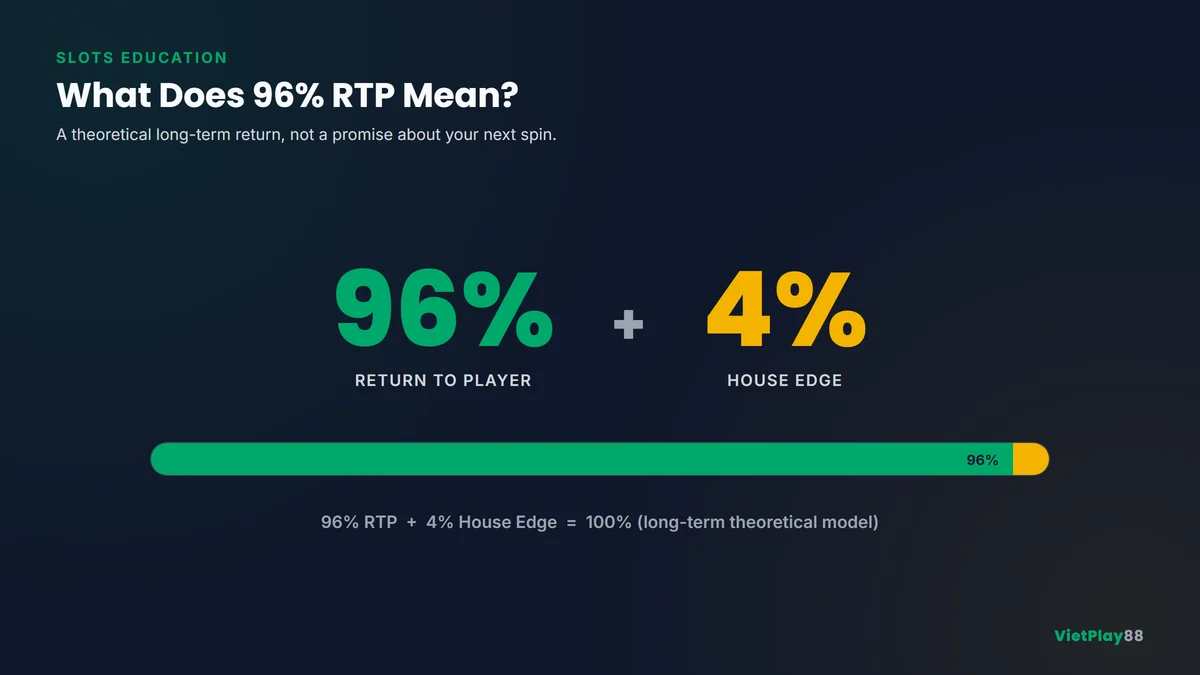



When an Online Slot displays 96% RTP, it does not mean a player will receive ₫96 back for every ₫100 wagered. Instead, 96% RTP describes the game's theoretical long-term Return to Player across a very large number of game rounds.
Understanding this distinction is important because RTP is frequently misunderstood as a prediction of what will happen during an individual gaming session.
A slot with 96% RTP is mathematically designed to return approximately 96% of total wagers over a very large number of spins.
The remaining 4% represents the theoretical house edge. In simple terms:
96% RTP + 4% House Edge = 100%However, this calculation applies to long-term mathematical performance—not one player, one session, or the next spin.
RTP stands for Return to Player. It is expressed as a percentage and represents how much of all money wagered on a game is theoretically returned to players over the long term.
For example:
| Measurement | Example |
|---|---|
| Slot RTP | 96% |
| Theoretical House Edge | 4% |
Suppose a game processes a hypothetical ₫1,000,000,000 in total wagers over an extremely large sample. At a theoretical RTP of 96%, the mathematical model corresponds to approximately:
This is a simplified mathematical illustration. It does not mean an individual player wagering ₫1,000,000 should expect to finish with ₫960,000.
This is where RTP is commonly misunderstood. Suppose a player starts with ₫500,000 and plays a 96% RTP slot. The final balance could theoretically be:
The RTP percentage does not determine which outcome will occur during that particular session. RTP becomes statistically meaningful across a very large number of game rounds rather than an individual player's short-term experience.
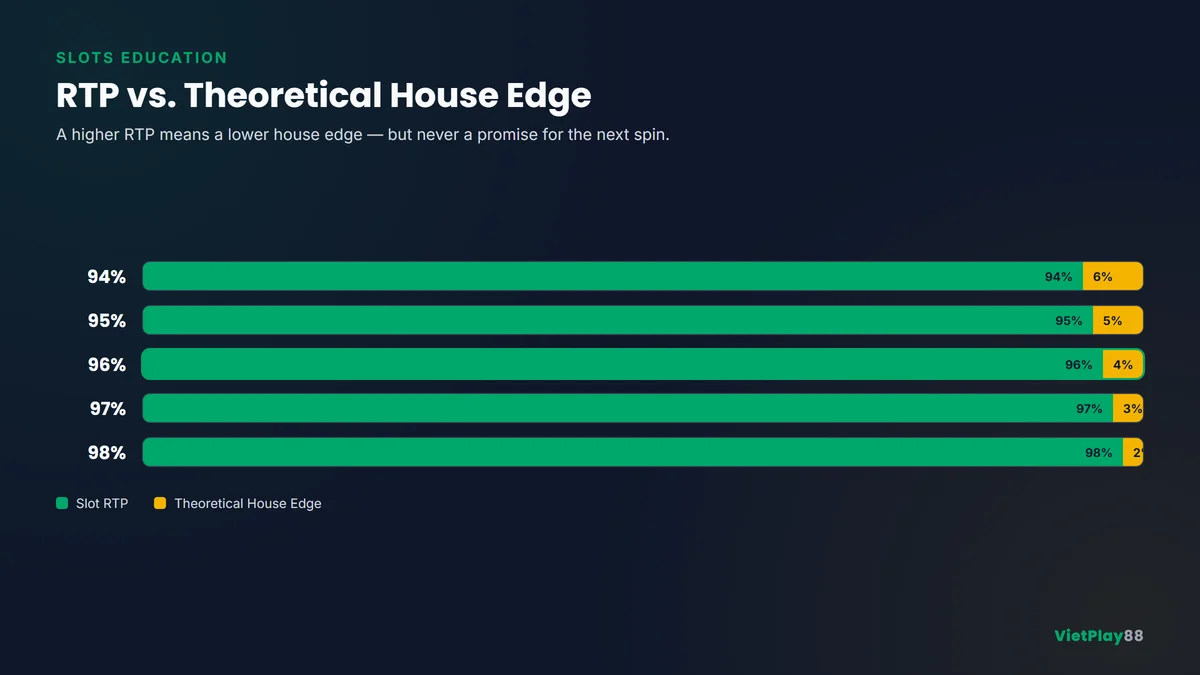
RTP and House Edge describe opposite sides of the same mathematical model. The basic relationship is:
100% − RTP = House EdgeTherefore:
100% − 96% = 4%A slot with a theoretical RTP of 96% consequently has a theoretical house edge of 4%.
| Slot RTP | Theoretical House Edge |
|---|---|
| 94% | 6% |
| 95% | 5% |
| 96% | 4% |
| 97% | 3% |
| 98% | 2% |
A higher RTP in this comparison corresponds to a lower theoretical house edge. It still does not predict short-term results.
A 96% RTP is commonly encountered among modern Online Slots, but RTP should not be the only characteristic considered when comparing casino games.
Players may encounter games displaying values such as:
The important point is that a higher theoretical RTP does not automatically mean the game will produce more winning spins during a particular session.
Other characteristics—especially Slot Volatility and Hit Frequency—affect how the gameplay experience behaves.
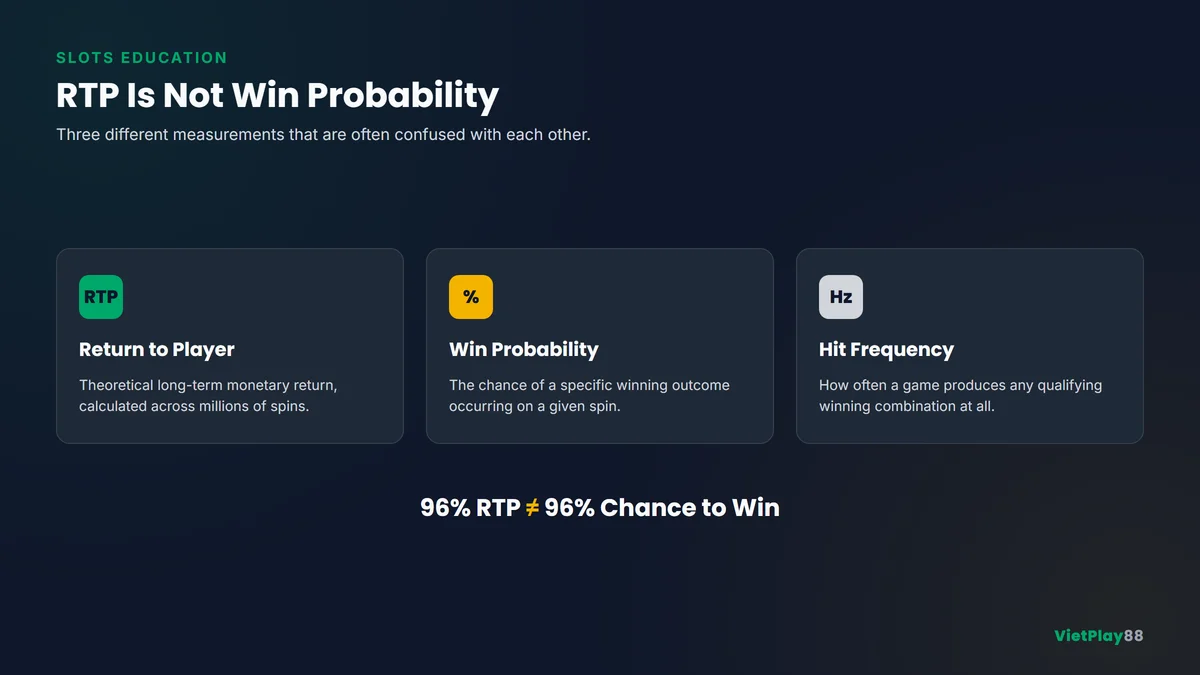
This distinction is particularly important. 96% RTP is not the same as a 96% probability of winning a spin. The measurements describe different characteristics.
Describes theoretical long-term monetary return.
Describes the probability of a particular winning outcome.
Describes how frequently a game produces a qualifying winning combination.
A slot can therefore have 96% RTP without providing anything close to a 96% chance of winning each individual spin.
No. There is no requirement for a 96% RTP slot to produce its theoretical return after:
Theoretical RTP is calculated across substantially larger samples. Short-term results can fluctuate considerably. This is why RTP should not be treated as a session-level prediction.
Individual outcomes in properly implemented RNG-based Online Slots are generated independently. For example:
Loss → Loss → Loss → Lossdoes not mean:
Next Spin → Must WinLikewise:
Win → Win → Windoes not mean the next spin must lose simply to immediately restore the theoretical RTP.
Believing that a particular outcome becomes "due" because of previous independent results is commonly associated with the gambler's fallacy. Previous independent spins do not provide a reliable prediction of the next one.
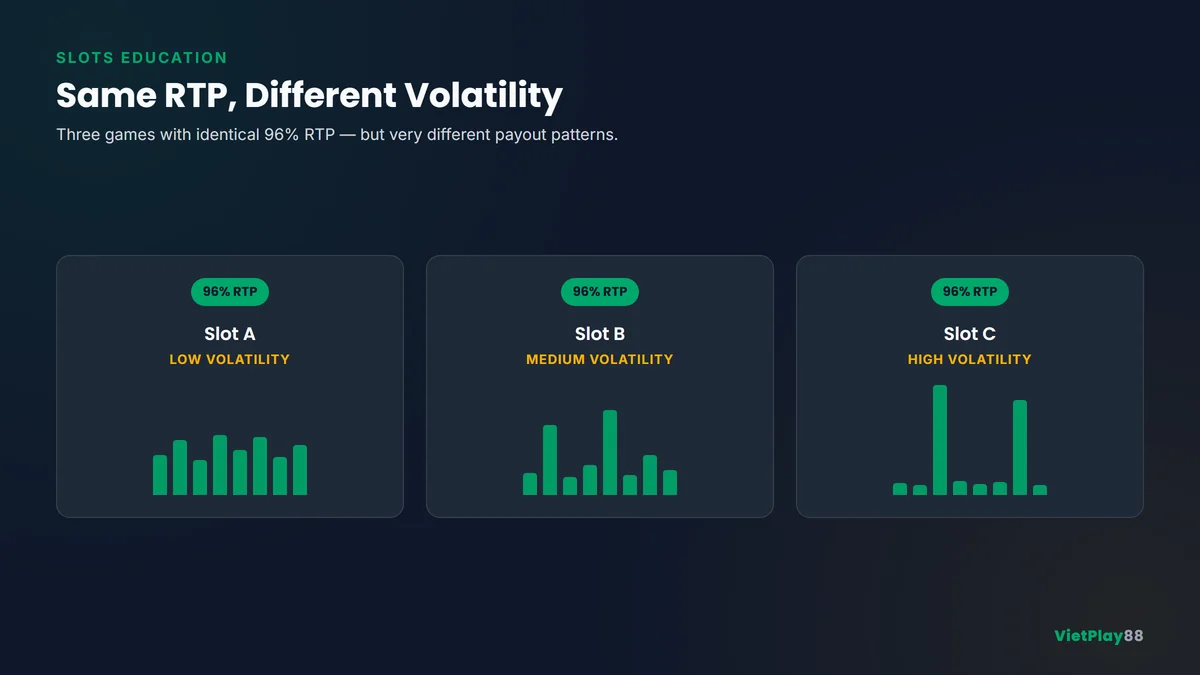
Two Online Slots can both display 96% RTP while providing substantially different gameplay patterns. For example:
| Game | RTP | Volatility | General Payout Pattern |
|---|---|---|---|
| Slot A | 96% | Low | More frequent, typically smaller payouts |
| Slot B | 96% | Medium | More balanced payout pattern |
| Slot C | 96% | High | Less frequent, potentially larger payouts |
The theoretical RTP is identical in this simplified comparison, but the distribution of potential payouts differs. A low-volatility game generally emphasizes more frequent smaller payouts, while a high-volatility game may concentrate more of its theoretical return into less frequent, potentially larger payouts.
Readers wanting a deeper explanation should continue to the Slot RTP & Volatility Guide.
Yes. Some game developers provide multiple mathematical configurations of the same slot title. For example, different certified versions could theoretically be configured at:
The visual appearance and core gameplay may remain similar while the configured RTP differs. For this reason, players interested in RTP should check the information provided for the specific game version available on the platform rather than assuming every version has identical settings.
Depending on the game, RTP information may appear under:
The exact location varies between software providers and games. Players should use the information displayed for the specific version being offered.
No. Consider two hypothetical games:
| Game | RTP |
|---|---|
| Game A | 96% |
| Game B | 97% |
Game B has the higher theoretical long-term return, but this does not mean someone playing Game B during one session will necessarily achieve better results than someone playing Game A. Short-term outcomes remain unpredictable.
The one-percentage-point difference describes long-term game mathematics rather than a promise about an individual session.
The easiest way to understand the concept is:
96% RTP = long-term mathematical return, not a personal refund rate.
It does not mean:
"Wager ₫100 and automatically receive ₫96 back."
Instead, the percentage describes how the game is mathematically designed to perform across extensive gameplay.
False. RTP and win probability are different measurements.
False. Previous independent outcomes do not make a future win due.
False. The 4% represents the theoretical house edge over the long term, not a maximum personal loss.
False in the short term. The higher RTP represents a mathematical long-term difference rather than guaranteed session performance.
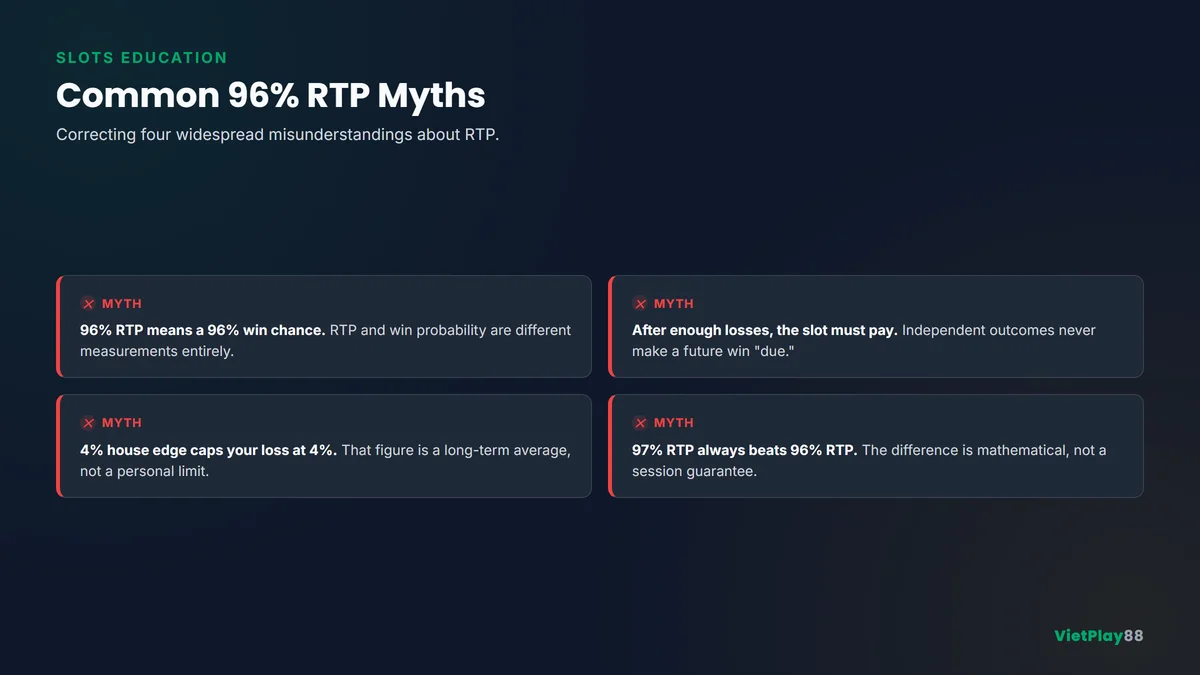
RTP is useful for understanding and comparing how Online Slots are mathematically designed, but it should never be treated as a method for predicting winnings.
Players should:
RTP provides information—not certainty. Readers who want a deeper look at healthy play habits can visit the Responsible Gaming guide.
RTP stands for Return to Player.
It means the game is theoretically designed to return approximately 96% of total wagers across a very large number of game rounds.
No. RTP measures theoretical monetary return rather than the probability of winning an individual spin.
The theoretical house edge is 4%.
Mathematically, 97% represents a higher theoretical long-term return. It does not guarantee better results during an individual session.
No. RTP cannot predict an individual spin.
No. Independent RNG outcomes do not make a particular future result due.
Understanding 96% RTP meaning becomes much easier once the percentage is viewed as a long-term mathematical characteristic rather than a promise about individual results.
A 96% RTP slot is theoretically designed around a 96% long-term return and a 4% house edge. Actual short-term results can differ substantially because individual outcomes remain unpredictable.
RTP is therefore most useful for understanding and comparing game mathematics. It should be considered alongside other characteristics such as volatility and Hit Frequency while maintaining realistic expectations and responsible gaming habits.
| Image | Suggested Filename | Status |
|---|---|---|
| Featured / Hero | what-does-96-rtp-mean.webp | Live |
| RTP vs House Edge | rtp-vs-house-edge.webp | Live |
| RTP vs Win Probability | rtp-vs-win-probability.webp | Live |
| Same RTP, Different Volatility | same-rtp-different-volatility.webp | Live |
| RTP Myths | slot-rtp-myths.webp | Live |