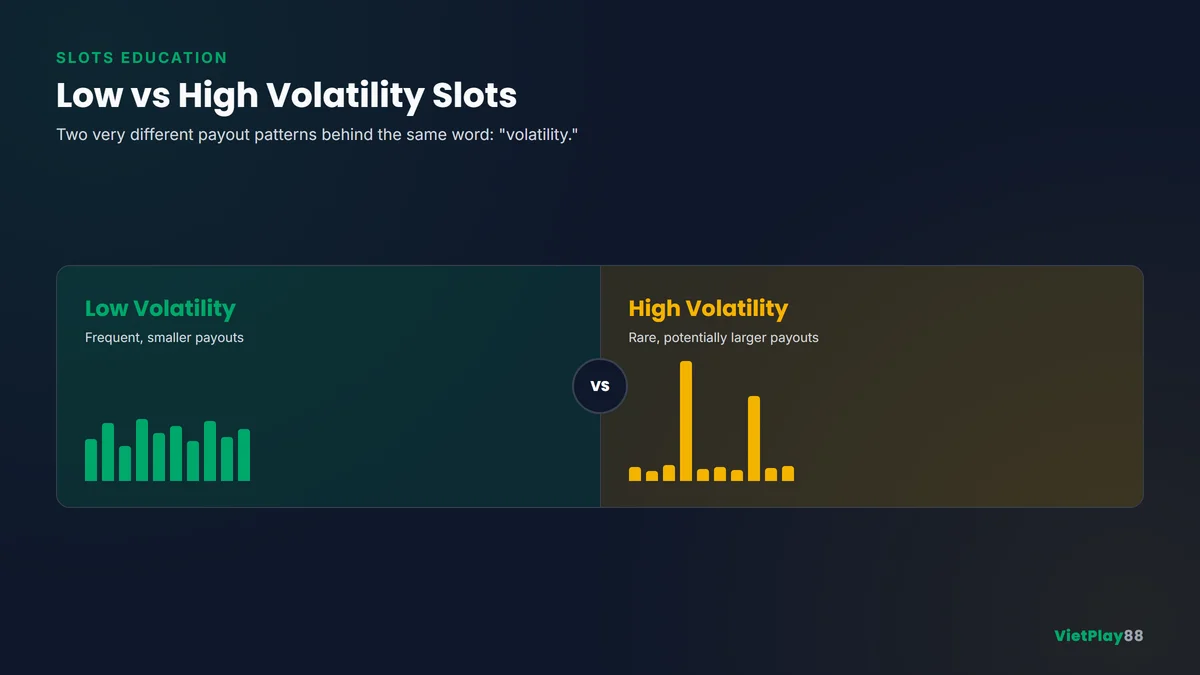
Low volatility slots generally distribute potential payouts more frequently in smaller amounts, while high volatility slots tend to produce less frequent wins with the possibility of larger individual payouts. Neither option is automatically better. The difference is primarily about how the mathematical payout pattern is structured.

Comparison infographic showing low versus high volatility slots with payout frequency and potential win size

TL;DR

The main difference between Low vs High Volatility Slots is how potential payouts are distributed.

Low Volatility Slots:

  • Generally produce winning combinations more frequently
  • Usually feature smaller average payouts
  • Tend to create steadier gameplay

High Volatility Slots:

  • Generally produce winning combinations less frequently
  • May offer larger individual payouts
  • Tend to produce greater balance fluctuations

Volatility does not indicate whether a slot is "better," and it does not predict what will happen during a particular session.

What Is Slot Volatility?

Slot Volatility, also called Slot Variance, describes the general pattern in which a slot game's potential payouts are distributed.

It primarily helps explain two characteristics:

  1. How frequently winning combinations may occur
  2. How large those potential wins may be

Most slots are commonly described as:

  • Low Volatility
  • Medium Volatility
  • High Volatility

This article focuses specifically on the difference between Low and High Volatility Slots.

What Are Low Volatility Slots?

Low Volatility Slots generally distribute a larger proportion of their potential payouts through more frequent, smaller wins.

A simplified example might look like:

Spin 1 → Small Win
Spin 2 → No Win
Spin 3 → Small Win
Spin 4 → Small Win
Spin 5 → No Win
Spin 6 → Small Win

The exact pattern is never guaranteed, but this illustrates the type of gameplay commonly associated with lower volatility.

Typical Characteristics of Low Volatility Slots

Low volatility games commonly feature:

  • More frequent winning combinations
  • Smaller average payout amounts
  • Lower short-term balance fluctuations
  • More consistent-feeling sessions

This does not mean every session will contain frequent wins. Every individual spin remains unpredictable.


What Are High Volatility Slots?

High Volatility Slots generally distribute potential payouts less frequently while allocating more of the game's mathematical return toward larger individual wins.

A simplified illustration might look like:

Spin 1 → No Win
Spin 2 → No Win
Spin 3 → No Win
Spin 4 → Small Win
Spin 5 → No Win
Spin 6 → Larger Win

Again, this is only an educational example and not a guaranteed pattern.

Typical Characteristics of High Volatility Slots

High volatility slots commonly feature:

  • Less frequent winning combinations
  • Larger potential individual payouts
  • Greater balance fluctuations
  • Bonus features that may contribute significantly to overall game return

High volatility does not mean that a large win is guaranteed after several losing spins.

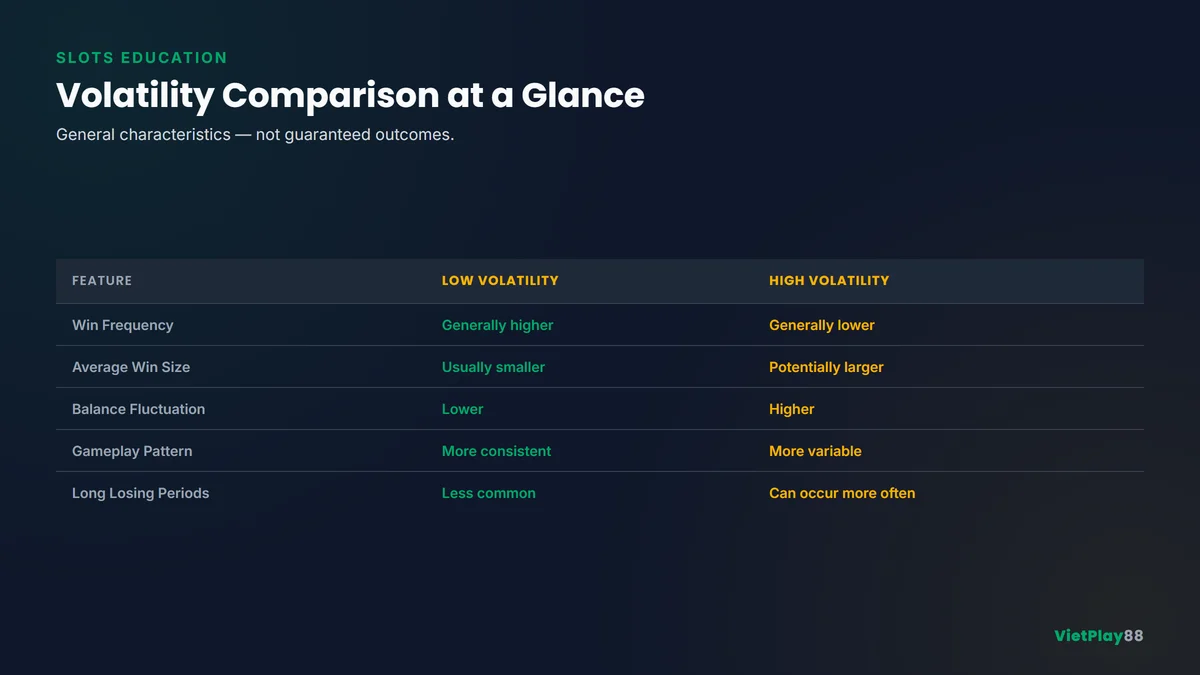
Low vs High Volatility Slots Comparison

FeatureLow Volatility SlotsHigh Volatility Slots
Win FrequencyGenerally higherGenerally lower
Average Win SizeUsually smallerPotentially larger
Balance FluctuationLowerHigher
Gameplay PatternMore consistentMore variable
Long Losing PeriodsGenerally less commonCan occur more often
Large Potential WinsUsually less emphasizedMore commonly emphasized

These are general characteristics rather than guaranteed outcomes.

Low and high slot volatility comparison showing frequency, payout size, and balance fluctuations

Does Low Volatility Mean Better Odds?

No. Low Volatility does not necessarily mean the player has better odds of winning overall. Volatility describes the distribution of payouts, not the game's total theoretical return.

For example:

GameRTPVolatility
Slot A96%Low
Slot B96%High

Both hypothetical games have the same theoretical RTP. However, their payout patterns can feel completely different. Slot A may distribute more of its theoretical return through smaller, more frequent wins. Slot B may distribute more through less frequent, potentially larger wins.

Does High Volatility Mean Bigger Wins?

High Volatility Slots are generally designed with greater potential payout variation. However, that does not mean every session produces large wins.

A player may encounter:

  • Small wins
  • Extended periods without winning combinations
  • Bonus rounds
  • Larger payouts
  • No significant wins during a session

Volatility describes mathematical behavior across extensive gameplay rather than guaranteeing any specific short-term experience.

Volatility vs RTP

Volatility and RTP are frequently confused. They are not the same measurement.

RTP

Return to Player represents the theoretical percentage of total wagers that a game is designed to return over a very large number of spins. Example: 96% RTP. Readers who want a full breakdown of this concept can read What Does 96% RTP Mean in Slots?

Volatility

Volatility describes how that theoretical return may be distributed. Therefore:

RTP = How much theoretically returns over the long term
Volatility = How potential payouts are distributed

This distinction explains why two games with the same RTP can feel completely different. Readers who want a deeper mathematical explanation can continue to the Slot RTP & Volatility Guide.

Low Volatility Example

Consider a simplified hypothetical slot session.

Starting Balance: ₫500,000

Example sequence:

RoundExample Result
1+₫10,000
2No Win
3+₫8,000
4+₫15,000
5No Win
6+₫7,000

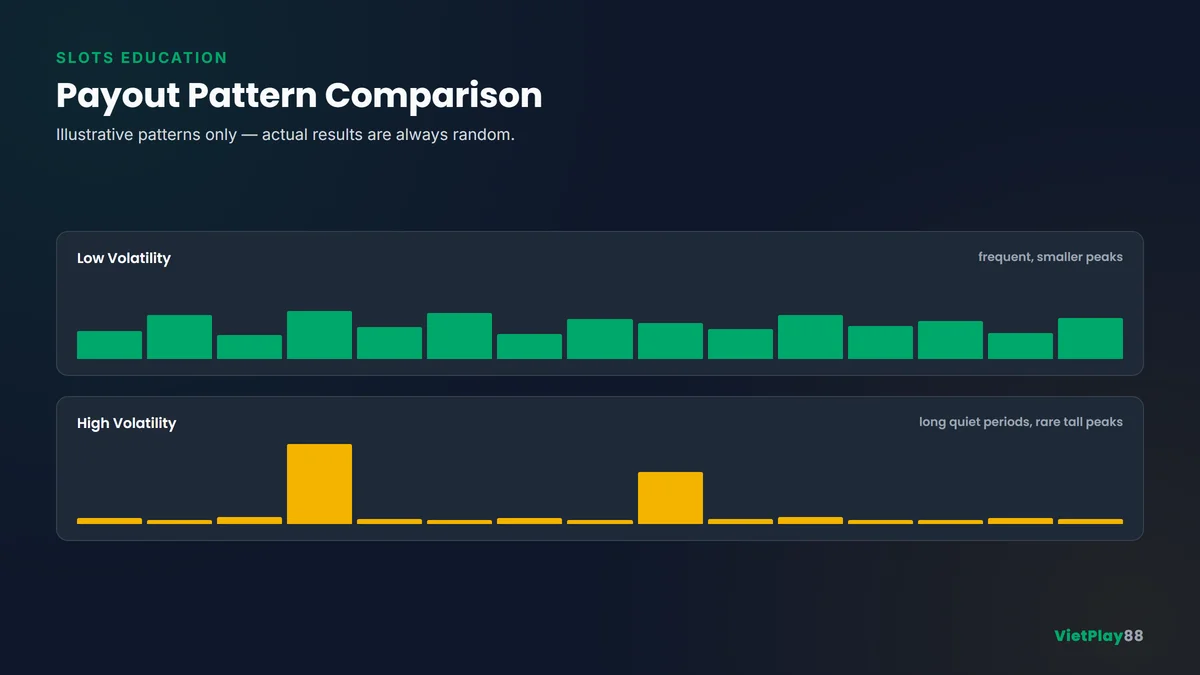
The pattern contains several smaller wins. This is broadly representative of how lower-volatility gameplay may feel, although actual results remain random.

High Volatility Example

Now consider another simplified hypothetical session.

Starting Balance: ₫500,000

RoundExample Result
1No Win
2No Win
3No Win
4+₫5,000
5No Win
6+₫150,000

The payout pattern is less consistent but includes a larger individual win. This is an illustration of volatility—not a prediction of how a particular slot will behave.

Payout pattern graph comparing frequent smaller wins in low volatility slots with less frequent larger wins in high volatility slots

What Is Medium Volatility?

Medium Volatility sits between the two extremes. It generally provides:

  • Moderate win frequency
  • Moderate payout sizes
  • A balance between smaller and larger wins

Medium volatility is common among many modern Video Slots. However, this article focuses specifically on the distinction between Low and High Volatility Slots.

What Is Hit Frequency?

Hit Frequency refers to how often a slot produces any qualifying winning combination. For example, a slot might theoretically have a hit frequency of approximately 25%.

This does not mean a player will win exactly once every four spins. It represents statistical game behavior over a larger sample.

Hit Frequency and Volatility are related concepts, but they are not identical. A slot can have:

  • Relatively frequent small wins
  • Less frequent larger wins
  • Different bonus frequencies

while maintaining its own specific volatility profile.

Which Volatility Is Better for Beginners?

There is no universally "best" volatility level. Different players may prefer different gameplay experiences.

Low Volatility May Appeal to Players Who Prefer:

  • More frequent smaller wins
  • Smoother balance movement
  • Less dramatic fluctuations
  • Longer entertainment sessions

High Volatility May Appeal to Players Who Prefer:

  • More variable gameplay
  • Potentially larger individual payouts
  • Bonus-focused mechanics
  • Greater balance fluctuations

The key consideration should be personal entertainment preference and responsible bankroll management.

Volatility and Bankroll Management

Volatility can affect how quickly a gaming balance fluctuates. For example, high-volatility games may experience longer stretches without significant wins.

Players choosing these games should understand that:

  • Losing sequences can occur.
  • Larger balance swings are possible.
  • Increasing wagers after losses does not change the game's mathematics.

Regardless of volatility, players should establish:

  • An entertainment budget
  • A session limit
  • Appropriate wager sizes
  • A stopping point

Bankroll management does not improve the mathematical odds of the game, but it helps maintain control over entertainment spending.

Common Volatility Myths

Myth 1: High Volatility Slots Eventually Have to Pay Big

False. A long losing sequence does not make a large payout due. Each independent spin remains unpredictable.

Myth 2: Low Volatility Slots Always Pay More Often

Low volatility generally describes more frequent smaller payouts over the game's mathematical model. It does not guarantee wins during an individual session.

Myth 3: High Volatility Means Higher RTP

False. RTP and Volatility are separate characteristics. A high-volatility game can have a lower, equal, or higher RTP than a low-volatility game.

Myth 4: Changing the Bet Changes Volatility

Generally, changing the wager amount does not transform a low-volatility game into a high-volatility game. Volatility is built into the game's mathematical design. Specific game features may behave differently, so the official game rules should always be checked.

How to Check a Slot's Volatility

Depending on the provider, volatility information may appear under:

  • Game Information
  • Help
  • Paytable
  • Rules
  • Provider Website

Some games use labels such as Low, Medium, or High. Others may use a numeric scale such as 1/5 through 5/5. Not every provider displays volatility directly.

Responsible Approach to Slot Volatility

Understanding volatility is useful for comparing gameplay styles, but it should never be used to predict the next payout.

Players should remember:

  • Every spin remains unpredictable.
  • A losing streak does not make a win due.
  • High volatility does not guarantee a large prize.
  • Low volatility does not guarantee frequent personal wins.
  • Gambling should remain within a planned entertainment budget, as outlined in the Responsible Gaming guide.
Responsible slot selection infographic comparing volatility with entertainment budget and session planning
01Frequently Asked Questions

Low Volatility Slots generally offer more frequent smaller payouts, while High Volatility Slots generally produce less frequent but potentially larger individual payouts.

No. RTP and Volatility are separate mathematical characteristics.

Not necessarily. Low volatility describes payout distribution rather than guaranteeing a higher probability of personal winnings.

No. High volatility can be associated with larger potential payout variation, but no specific result is guaranteed.

Yes. Two games can have identical theoretical RTP percentages while distributing potential payouts differently.

The choice depends on personal entertainment preferences, comfort with balance fluctuations, and responsible budgeting.

Key Takeaways

  • Slot Volatility describes the frequency and potential size of payouts.
  • Low Volatility Slots generally emphasize more frequent, smaller wins.
  • High Volatility Slots generally emphasize less frequent, potentially larger wins.
  • Volatility and RTP are different measurements.
  • High volatility does not mean higher RTP.
  • Low volatility does not guarantee frequent personal wins.
  • Previous spins do not make future results due.
  • Volatility should be used to understand gameplay style, not predict outcomes.

Final Thoughts

The difference between Low vs High Volatility Slots comes down primarily to payout distribution.

Low-volatility games generally provide more frequent smaller payouts and smoother balance movement, while high-volatility games generally produce larger fluctuations and less frequent opportunities for potentially larger wins.

Neither volatility level is automatically better. Understanding the distinction allows players to compare Online Slots according to gameplay preference while maintaining realistic expectations about random outcomes.

Volatility should therefore be considered alongside RTP, Hit Frequency, bonus features, and responsible bankroll management rather than being used as a prediction tool.

Suggested Images for This Article

ImageSuggested FilenameStatus
Featured / Herolow-vs-high-volatility-slots.webpLive
Volatility Comparisonlow-high-slot-volatility-comparison.webpLive
Payout Pattern Graphslot-volatility-payout-patterns.webpLive
Responsible Volatility Selectionresponsible-slot-volatility-selection.webpLive
Samantha Lee
Written by

Samantha Lee

Samantha Lee is a professional content writer with over four years of experience creating engaging, research-driven, and audience-focused content for multiple industries, including iGaming, wellness, beauty, and lifestyle. Her structured approach focuses on in-depth topic research, clear article structure, and accurate, reader-friendly writing.